The Endless Aisle, Minus the Hype
The endless aisle had its moment, then quietly disappeared from the pitch decks that invented it. The problem it was supposed to solve never went away. The execution was the part that failed.
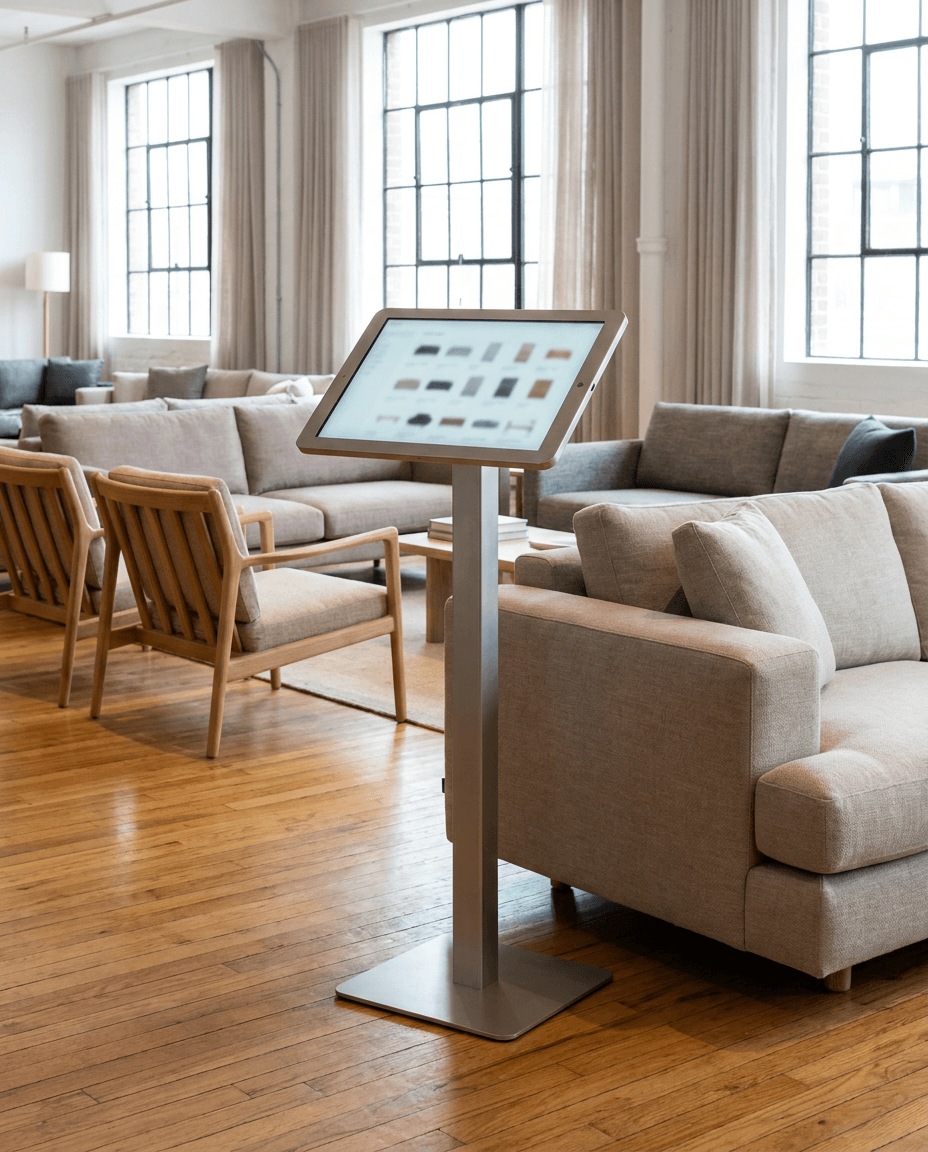
"Endless aisle" was one of the most heavily marketed retail-tech ideas of the last decade. Kiosk hardware companies and POS vendors pitched the same promise: put a large touchscreen on the floor, connect it to "everything," and a customer who can't find what they want in the showroom finds it anyway. Then the marketing quietly stopped. Walk a dozen furniture showrooms today and odds are decent at least one has a kiosk stand in a back corner, screen dark, that nobody has walked a customer to in months.
The reason to revisit it isn't nostalgia. The underlying problem never went away. A showroom, no matter how large, can physically floor only a fraction of what a retailer can actually sell — one fabric per sectional instead of the eleven a manufacturer offers, one size of a bedroom set instead of three. A customer who wants the sectional in a different fabric, or the same bedroom in a bigger size, represents a sale the floor space cannot physically hold, no matter how well the store is merchandised. That constraint is structural. No floor plan fixes it.
Why did the first wave of showroom kiosks fail?
Ask an RSA who lived through the first wave why the kiosk stopped getting used, and the answer is rarely about the hardware. It's usually "it showed things we didn't actually have" or "the price on the screen wasn't the price at the register." The kiosk in most installs ran on its own catalog feed, synced on its own schedule, priced by its own rules — a system bolted onto the store rather than wired into it. What the screen showed and what the store could actually sell, at the price it actually charged, were two different things that happened to look similar.
That gap mattered more than the vendors selling the hardware ever priced in. An RSA's job is to close a sale, and every promise they make is one they're personally on the hook for. Send a customer to a kiosk that quotes a price the register won't honor, or shows a fabric discontinued eight months ago, and the RSA doesn't get a quiet do-over — they get a customer who now doubts the next thing the store tells them too. After that happens once or twice, the RSA stops walking anyone to the kiosk, and an expensive install becomes furniture for the corner.
The other mistake was framing. Most first-generation kiosks were pitched as self-service — the same logic as a self-checkout lane, applied to a category where it doesn't fit. Furniture is high-consideration and expensive, and most shoppers want a person's read on scale, durability, and whether a fabric holds up with a dog in the house. A self-service screen in a category where people want help was built for the wrong moment, before the data underneath it was even wrong.
What is a kiosk actually for, then?
The useful version of this idea isn't self-service at all — it's a tool the RSA reaches for, in front of the customer, at one moment: when the customer wants something the floor doesn't have. Not a browsing destination, not a lobby attraction, not a way to trim headcount. Its job is keeping a customer in the building during the "we don't have that in blue" conversation, instead of them pulling out a phone and leaving to go search a competitor.
Framed that way, the kiosk isn't competing with the RSA for the sale — it's their tool for finishing a conversation the floor plan alone can't finish. Pull up the sectional in the fabric the customer actually wants, confirm it's really available at the price already being discussed, and keep the sale moving without a trip back to a desk or a hold while someone calls another location.
What actually has to be true for a kiosk to earn its floor space?
None of this is exotic. It just has to be genuinely true, not merely claimed in a sales demo.
- 01The same catalog and pricing as everything else. Not a synced copy — the kiosk reads the identical product and price data the point of sale and website read. A fabric discontinued this morning is gone from the kiosk this morning.
- 02Search that tolerates how customers actually talk. Nobody walks up and types a SKU. They say "gray sectional with the chaise." Search has to work with that, not the vocabulary of a merchandiser.
- 03Images that survive a large screen. A photo shot for a thumbnail looks obviously wrong at fifty-plus inches — soft focus, visible compression, colors that don't match the swatch six feet away.
- 04A straight line from screen to written order. If confirming a fabric still means an RSA re-keys the whole order by hand at a desk, the kiosk saved nothing.
- 05Attribution. A way to know whether a kiosk session actually touched a sale, so the store isn't guessing whether the thing earns its footprint.
How should a retailer decide whether to keep it?
Treat a kiosk like any other fixture competing for floor space, not a technology purchase with a permanent pass. Track ordinary retail questions: how many kiosk sessions end in a written order that visit or within a few days; whether kiosk-assisted sales carry a higher attach rate on delivery upgrades or protection plans; and — the most honest signal — whether RSAs reach for it on their own, because it makes closing easier rather than adding a step.
Where does AI actually help here, and where is it decoration?
Style and visual similarity search is real and useful here. A customer pointing at a sofa and saying "something like this but warmer" is a common moment on a showroom floor, and matching that against images of what's actually in stock — not a generic web search — is a problem AI is well suited to, because it's narrow, visual, and grounded in a catalog the store controls.
A chatbot bolted onto the kiosk is usually decoration. Furniture is high-consideration, and a chat window doesn't fix the trust problem that killed the first generation — it puts a conversational interface on the same catalog, and if that catalog is still wrong, the chatbot will confidently repeat the mistake in sentence form instead of a product tile. A kiosk earns AI features after the catalog underneath it is trustworthy, not as a way to paper over one that isn't.
A dusty tablet nobody trusts is worse than no kiosk at all.
- Endless aisle
- A screen on the showroom floor that extends a store's assortment beyond what's physically on display, without physically holding the inventory.
- Attach rate
- The share of a sale that includes add-ons — delivery upgrades, protection plans, accessories — worth tracking separately for kiosk-assisted sales.
- Written order
- An order the customer has signed and deposited on, as opposed to a browsing session that never converts — the real measure of whether a kiosk session mattered.
- Attribution
- The ability to trace a sale back to the touchpoints that led to it — here, knowing whether a kiosk session preceded a written order rather than guessing.
For most stores that already own a dusty kiosk stand, none of this requires new hardware. It requires the kiosk to stop being a separate system and start being a window onto the same catalog everything else runs on. Get that right, and the endless aisle stops being a marketing phrase and starts being an ordinary tool an RSA reaches for without thinking twice.
Common questions
- Why did showroom kiosks fail the first time around?
- Mostly because they ran on a separate catalog and pricing feed than the rest of the store. When the kiosk showed a price the register wouldn't honor or a discontinued fabric, RSAs stopped trusting it and stopped walking customers to it — an expensive install became an unused fixture.
- Is a showroom kiosk supposed to be self-service?
- No — treating it that way was one of the original mistakes. Furniture is high-consideration and most shoppers want a person's input. The useful version is a tool an RSA uses in front of the customer, not an unattended browsing station.
- What does a furniture kiosk need to actually work?
- The same catalog and pricing data as the point of sale and website, search that tolerates plain-language descriptions rather than SKUs, images that hold up at large screen size, and a way to turn what's on screen into a written order without re-keying it.
- How should a retailer measure whether a kiosk is worth keeping?
- Track it like any other floor fixture: how many sessions end in a written order, whether kiosk-assisted sales carry a higher attach rate on add-ons, and whether RSAs use it voluntarily. If none of that moves after a fair trial, removing it is reasonable.
- Does AI make showroom kiosks better?
- Selectively. Visual similarity search — matching "something like this but warmer" against in-stock inventory — is a genuine use of AI here. A chatbot layered on top is usually decoration, since it doesn't fix the catalog-accuracy problem that sank the first generation.
One Tap Commerce
Editorial desk
Written by the team that builds One Tap Commerce — the operating system for furniture retail. We work with independent and multi-location furniture retailers on catalog, point of sale, delivery, and the books.